

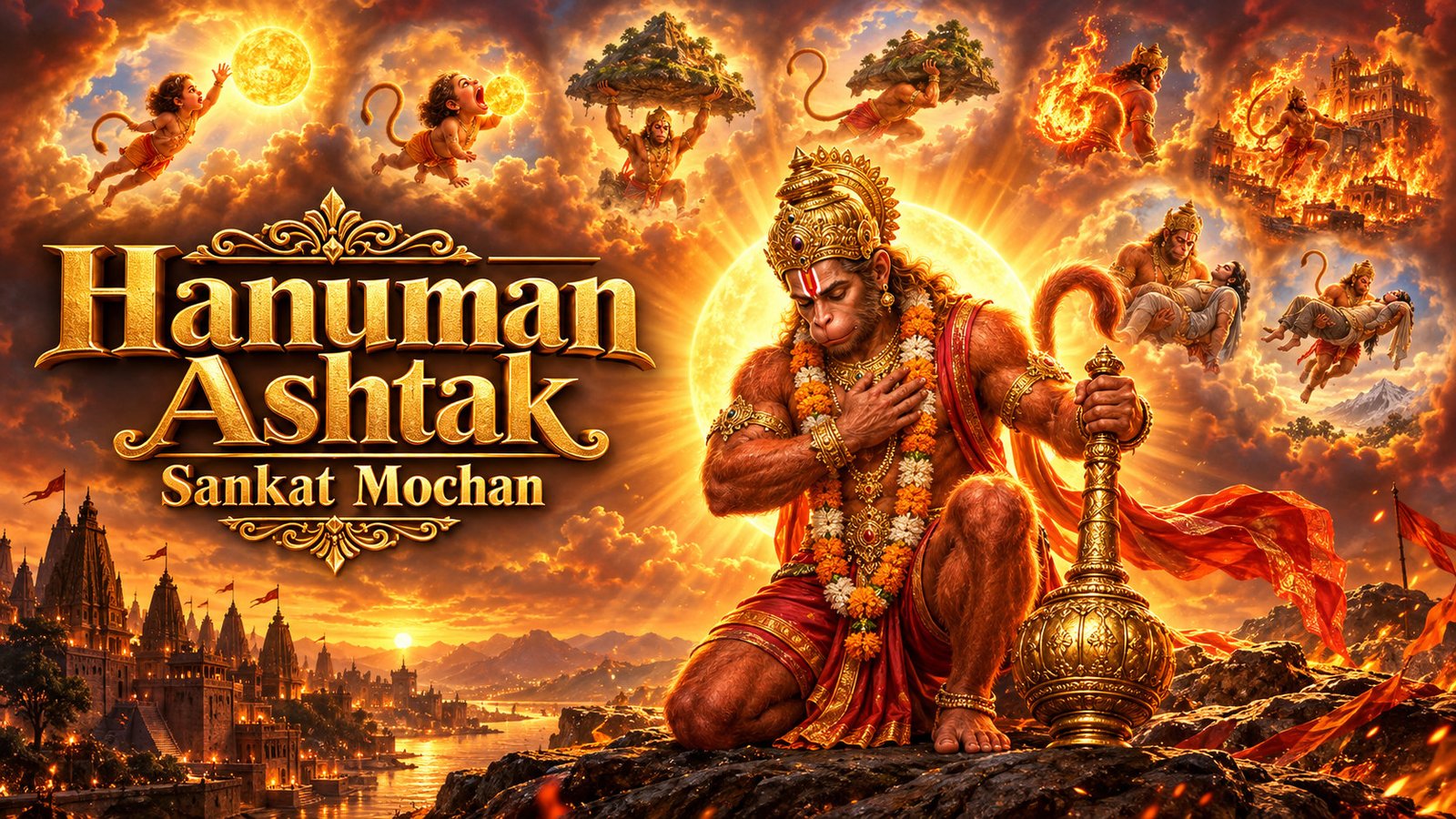
हनुमान अष्टक का अर्थ
हनुमान अष्टक भगवान हनुमान की स्तुति में रचित आठ छंदों का एक शक्तिशाली स्तोत्र है, जिसके अंत में एक समापन दोहा है। प्रत्येक छंद में रामायण की एक प्रमुख घटना का स्मरण किया गया है: जन्म काल में सूर्य को निगलना, बालि के भय से सुग्रीव की रक्षा, सीता की खोज, लंका दहन, लक्ष्मण की प्राण-रक्षा, नागपाश से मुक्ति, और अहिरावण का वध। और हर छंद उसी एक पंक्ति पर समाप्त होता है: “को नहिं जानत है जग में कपि, संकटमोचन नाम तिहारो”। इस जगत में कौन नहीं जानता कि इस वानर (हनुमान) का नाम ही संकटमोचन है। यही कारण है कि यह स्तोत्र विशेष रूप से संकट, भय और कठिन समय में पढ़ा जाता है।
श्लोक 1
बाल समय रबि भक्षि लियो तब तीनहुँ लोक भयो अँधियारो।
ताहि सों त्रास भयो जग को यह संकट काहु सों जात न टारो।
देवन आनि करी बिनती तब छाँड़ि दियो रबि कष्ट निवारो।
को नहिं जानत है जग में कपि संकटमोचन नाम तिहारो॥१॥
अर्थ: बचपन में हनुमान जी ने सूर्य को फल समझकर निगल लिया, जिससे तीनों लोकों में अंधकार छा गया। इससे सारा संसार भयभीत हो गया और यह संकट किसी से टाला न गया। तब देवताओं ने आकर विनती की, जिसके बाद उन्होंने सूर्य को छोड़ दिया और कष्ट दूर हुआ। इस जगत में कौन नहीं जानता कि इस वानर का नाम ही संकटमोचन है!
श्लोक 2
बालि की त्रास कपीस बसै गिरि जात महाप्रभु पंथ निहारो।
चौंकि महा मुनि साप दियो तब चाहिय कौन बिचार बिचारो।
कै द्विज रूप लिवाय महाप्रभु सो तुम दास के सोक निवारो।
को नहिं जानत है जग में कपि संकटमोचन नाम तिहारो॥२॥
अर्थ: बालि के भय से सुग्रीव पर्वत पर रहते थे और श्रीराम के आने की राह देखते थे। मुनि के शाप की चिंता में उलझे होने पर क्या उपाय हो सकता था? तब हनुमान जी ने ब्राह्मण का रूप धारण कर अपने सेवक सुग्रीव का शोक दूर किया।
श्लोक 3
अंगद के संग लेन गये सिय खोज कपीस यह बैन उचारो।
जीवत ना बचिहौ हम सो जु बिना सुधि लाय इहाँ पगु धारो।
हेरी थके तट सिंधु सबै तब लाय सिया-सुधि प्रान उबारो।
को नहिं जानत है जग में कपि संकटमोचन नाम तिहारो॥३॥
अर्थ: सीता जी की खोज के लिए अंगद के साथ गए हनुमान जी ने प्रण किया कि बिना सीता का पता लिए वापस नहीं लौटेंगे। समुद्र तट पर खोजते-खोजते सब थक गए, तभी हनुमान जी सीता जी का समाचार लेकर आए और सबके प्राण बचाए।
श्लोक 4
रावण त्रास दई सिय को सब राक्षसी सों कहि सोक निवारो।
ताहि समय हनुमान महाप्रभु जाय महा रजनीचर मारो।
चाहत सीय असोक सों आगि सु दै प्रभु मुद्रिका सोक निवारो।
को नहिं जानत है जग में कपि संकटमोचन नाम तिहारो॥४॥
अर्थ: रावण ने सीता जी को कष्ट दिया और राक्षसियों ने उन्हें और दुखी किया। उसी समय हनुमान जी ने जाकर भयंकर राक्षस का वध किया। जब सीता जी अशोक वाटिका में अग्नि में प्रवेश करने को तैयार थीं, तब प्रभु की मुद्रिका (अंगूठी) देकर उनका शोक दूर किया।
श्लोक 5
बान लग्यो उर लछिमन के तब प्रान तजे सुत रावन मारो।
लै गृह बैद्य सुषेन समेत तबै गिरि द्रोण सु बीर उपारो।
आनि सजीवन हाथ दई तब लछिमन के तुम प्रान उबारो।
को नहिं जानत है जग में कपि संकटमोचन नाम तिहारो॥५॥
अर्थ: जब लक्ष्मण जी की छाती में बाण लगा और मेघनाद ने उन्हें मृत समझ लिया, तब हनुमान जी वैद्य सुषेण सहित द्रोणागिरि पर्वत को ही उठा लाए और संजीवनी बूटी देकर लक्ष्मण जी के प्राण बचाए।
श्लोक 6
रावन युध अजान कियो तब नाग कि फाँस सबै सिर डारो।
श्रीरघुनाथ समेत सबै दल मोह भयो यह संकट भारो।
आनि खगेस तबै हनुमान जु बंधन काटि सुत्रास निवारो।
को नहिं जानत है जग में कपि संकटमोचन नाम तिहारो॥६॥
अर्थ: युद्ध में जब रावण ने नागपाश से सबके सिर बांध दिए, तो श्रीरघुनाथ सहित पूरी सेना मूर्छित हो गई। यह भारी संकट था। तब हनुमान जी गरुड़ जी (खगेश) को लाए, जिन्होंने बंधन काटकर संकट दूर किया।
श्लोक 7
बंधू समेत जबै अहिरावन लै रघुनाथ पताल सिधारो।
देबिन्हीं पूजि भलि विधि सों बलि देउ सबै मिलि मंत्र विचारो।
जाये सहाय भयो तब ही अहिरावन सैन्य समेत सँहारो।
को नहिं जानत है जग में कपि संकटमोचन नाम तिहारो॥७॥
अर्थ: जब अहिरावण अपने भाई सहित श्रीराम-लक्ष्मण को पाताल ले गया और देवी की पूजा कर उन्हें बलि देने का विचार किया, तब हनुमान जी सहायक बनकर पहुंचे और अहिरावण को उसकी सेना सहित नष्ट कर दिया।
श्लोक 8
काज किये बड़ देवन के तुम बीर महाप्रभु देखि बिचारो।
कौन सो संकट मोर गरीब को जो तुमसों नहिं जात है टारो।
बेगि हरो हनुमान महाप्रभु जो कछु संकट होए हमारो।
को नहिं जानत है जग में कपि संकटमोचन नाम तिहारो॥८॥
अर्थ: हे महाप्रभु, आपने देवताओं के लिए भी बड़े-बड़े कार्य किए हैं। विचार कीजिए, इस दीन के किस संकट को आप दूर नहीं कर सकते? हे हनुमान जी, हमारा जो भी संकट है, उसे शीघ्र दूर कीजिए।
समापन दोहा
लाल देह लाली लसे, अरु धरि लाल लंगूर।
वज्र देह दानव दलन, जय-जय-जय कपि सूर॥
अर्थ: आपका शरीर लाल रंग से सुशोभित है और लाल लंगूर धारण किए हैं; वज्र के समान बलशाली शरीर वाले, राक्षसों का नाश करने वाले वीर वानर की जय हो, जय हो, जय हो!
लाभ
संकट से रक्षा: नाम ही “संकटमोचन” है। यह हर प्रकार के संकट, भय और बाधा को दूर करने के लिए पढ़ा जाता है।
साहस और सुरक्षा: कठिन परिस्थितियों और खतरे के समय साहस व सुरक्षा की भावना देता है।
दृढ़ विश्वास: रामायण की आठ प्रमुख घटनाओं का स्मरण भक्त में यह विश्वास जगाता है कि हनुमान जी हर संकट में सहायता करते हैं।
मानसिक शांति: श्रद्धा सहित नियमित पाठ से भय और चिंता कम होती है।
निष्कर्ष
हनुमान अष्टक आठ छंदों और एक समापन दोहे का संक्षिप्त किन्तु अत्यंत प्रभावशाली स्तोत्र है, जो रामायण की आठ प्रमुख घटनाओं के माध्यम से हनुमान जी की संकटमोचन शक्ति का स्मरण कराता है। श्रद्धा-भाव से किया गया पाठ भक्त को साहस, सुरक्षा और मानसिक शांति प्रदान करता है।
संक्षिप्त प्रश्नोत्तर
हनुमान अष्टक कब पढ़ें?
किसी भी समय पढ़ा जा सकता है, परंतु विशेष रूप से संकट, भय या कठिनाई के समय, साथ ही मंगलवार, शनिवार और हनुमान जयंती पर।
हनुमान अष्टक और हनुमान चालीसा में क्या अंतर है?
चालीसा 40 चौपाइयों की व्यापक स्तुति है, जबकि अष्टक केवल 8 छंदों में रामायण की आठ वीरतापूर्ण घटनाओं पर केंद्रित है। हर छंद उसी “संकटमोचन” पंक्ति पर समाप्त होता है। संकट के समय अक्सर इसे विशेष रूप से पढ़ा जाता है।
क्या इसे रोज पढ़ा जा सकता है?
हां, इसे प्रतिदिन श्रद्धापूर्वक पढ़ा जा सकता है। यह हनुमान चालीसा या बजरंग बाण के साथ भी पढ़ा जा सकता है।
Meaning of Hanuman Ashtak
Hanuman Ashtak is a powerful eight-verse hymn of praise to Lord Hanuman, closing with a final doha. Each verse recalls a key episode from the Ramayana: swallowing the sun as a child, protecting Sugriva from Bali’s fear, searching for Sita, burning Lanka, saving Lakshman’s life, cutting the serpent-noose bonds, and destroying Ahiravan. Every verse ends with the same refrain: “Ko nahin jaanat hai jag mein kapi, sankat mochan naam tihaaro”, meaning who in this world does not know that this monkey’s (Hanuman’s) name is Sankatmochan, remover of troubles. This is why the hymn is recited especially in times of crisis, fear, and hardship.
Verse 1
Baal samai ravi bhakshi liyo tab, teenahu loka bhayo andhiyaro
Taahi so traas bhayo jag ko, yah sankat kaahu so jaat na taaro
Devan aani kari bintee tab, chhaadi diyo ravi kasht niwaaro
Ko nahin jaanat hai jag mein kapi, sankat mochan naam tihaaro ॥1॥
Meaning: In his childhood, Hanuman swallowed the sun, mistaking it for a fruit, plunging the three worlds into darkness. The whole world was struck with panic, and no one could resolve this crisis. Then the Devas came and pleaded with him, so he released the sun and the trouble was removed. Who in this world does not know that this monkey’s name is Sankatmochan, remover of troubles!
Verse 2
Baali ki traas kapees basai giri, jaat mahaaprabhu panth nihaaro
Chauki mahaa muni saap diyo tab, chahiy kaun bichaar bichaaro
Kai dwij roop liwaay mahaaprabhu, so tum daas ke sok niwaaro
Ko nahin jaanat hai jag mein kapi, sankat mochan naam tihaaro ॥2॥
Meaning: Fearing Bali, King Sugriva lived on the mountain, watching the path for the great lord to arrive. Troubled by the memory of a sage’s curse, what solution could there be? Taking the form of a Brahmin, the great lord Hanuman removed the sorrow of his servant, Sugriva.
Verse 3
Angad ke sang lain gaye Siya, khoj kapees yah bain uchaaro
Jeevat na bachihau hum so ju, bina sudhi laay ihaan pag dhaaro
Heri thake tat sindhu sabai, tab laay Siya-sudhi praan ubaaro
Ko nahin jaanat hai jag mein kapi, sankat mochan naam tihaaro ॥3॥
Meaning: Hanuman went with Angad and the search party to look for Sita, vowing they would not return alive without news of her. Exhausted from searching along the ocean’s shore, Hanuman then brought news of Sita and saved everyone’s lives.
Verse 4
Raavan traas dayee Siya ko sab, raakshasi so kahi sok niwaaro
Taahi samay Hanuman mahaaprabhu, jaay mahaa rajneechhar maaro
Chaahat Siya Ashok so aagi su, dai prabhu mudrika sok niwaaro
Ko nahin jaanat hai jag mein kapi, sankat mochan naam tihaaro ॥4॥
Meaning: Ravana tormented Sita, and the demonesses added to her sorrow. At that time, the great lord Hanuman went and slew the fearsome demon. When Sita was about to enter the fire in the Ashoka grove out of despair, the lord removed her sorrow by giving her Rama’s ring as proof.
Verse 5
Baan lagyo ur Lakshman ke tab, praan taje sut Raavan maaro
Lai griha baidya Sushen samet, tabai giri Dron su veer upaaro
Aani Sanjeevan haath dai, tab Lakshman ke tum praan upaaro
Ko nahin jaanat hai jag mein kapi, sankat mochan naam tihaaro ॥5॥
Meaning: When an arrow struck Lakshman’s chest and Meghnad (Ravana’s son) believed he had killed him, Hanuman brought the physician Sushena along with the entire Dronagiri mountain, and by bringing the Sanjeevani herb, saved Lakshman’s life.
Verse 6
Raavan yudh ajaan kiyo tab, naag ki phaas sabhi sir daaro
Shri Raghunath samet sabai dal, moh bhayo yah sankat bhaaro
Aani Khagesh tabai Hanuman ju, bandhan kaati sutraas niwaaro
Ko nahin jaanat hai jag mein kapi, sankat mochan naam tihaaro ॥6॥
Meaning: When Ravana, in desperation, bound everyone’s heads with the serpent-noose weapon (Nagpaash), Sri Rama and the entire army fell unconscious, a heavy calamity. Then Hanuman brought Garuda, the enemy of serpents, who cut the bonds and removed the affliction.
Verse 7
Bandhu samet jabai Ahiraavan, lai Raghunath pataal sidhaaro
Devhi pooji bhali vidhi so bali, deu sabai mili mantra vichaaro
Jaay sahaay bhayo tab hi, Ahiraavan sainya samet sanhaaro
Ko nahin jaanat hai jag mein kapi, sankat mochan naam tihaaro ॥7॥
Meaning: When Ahiravan, along with his brother, took Rama and Lakshman to the netherworld and, after worshipping the goddess, planned with counsel to sacrifice them, Hanuman came to their aid and destroyed Ahiravan along with his army.
Verse 8
Kaaj kiye barh dewan ke tum, veer mahaaprabhu dekhi bichaaro
Kaun so sankat mohin gareeb ko, jo tum so nahin jaat hai taaro
Begi haro Hanuman mahaaprabhu, jo kuch sankat hoya hamaaro
Ko nahin jaanat hai jag mein kapi, sankat mochan naam tihaaro ॥8॥
Meaning: O brave great lord, you have accomplished great deeds even for the Devas. Consider this. What calamity of this humble one can you not remove? O Hanuman, swiftly remove whatever crisis is ours.
Closing Doha
Laal deh laalee lase, aru dhari laal langoor.
Bajra deh daanav-dalan, jai jai jai kapi soor.
Meaning: Your body is red and radiant, and you bear a red tail; with a form as mighty as a thunderbolt, destroyer of demons. Victory, victory, victory to the brave monkey warrior!
Benefits
Protection from crisis: the very name “Sankatmochan” means remover of troubles, recited for relief from every kind of danger, fear, and obstacle.
Courage and safety: instills a sense of courage and protection during difficult or dangerous situations.
Steady faith: recalling eight major episodes from the Ramayana reinforces the devotee’s faith that Hanuman comes to the rescue in every crisis.
Peace of mind: regular, faithful recitation is believed to reduce fear and anxiety.
Conclusion
The Hanuman Ashtak is a short but powerful hymn of eight verses and a closing doha that, through eight major episodes from the Ramayana, recalls Hanuman’s power to remove crises (Sankatmochan). Recited with sincere faith, it brings the devotee courage, protection, and peace of mind.
Frequently Asked Questions
When should I recite the Hanuman Ashtak?
It can be recited any time, but is especially popular during times of crisis, fear, or hardship, as well as on Tuesdays, Saturdays, and Hanuman Jayanti.
What is the difference between the Hanuman Ashtak and the Hanuman Chalisa?
The Chalisa is a broader, 40-verse hymn of praise, while the Ashtak is more compact, just 8 verses, each focused on one heroic episode from the Ramayana and closing with the same “Sankatmochan” refrain. It is often recited specifically when facing a difficulty.
Can it be recited daily?
Yes, it can be recited daily with sincere devotion, and is often paired with the Hanuman Chalisa or Bajrang Baan.
जय श्री राम। जय हनुमान। 🚩
Jai Shri Ram. Jai Hanuman. 🚩